
Permits & Licensing Guide
Restaurant Permit Renewals: Complete Guide for 2026 Compliance
July 21, 2026 · 20 min read · 4,892 words
Maria Santos had it all figured out. Her Miami Beach restaurant passed every inspection during the opening process. Health permit: approved. Fire safety: cleared. Business license: filed. She even kept all the certificates in a neat binder behind the bar.
Eighteen months later, Maria gets a knock on her door at 10 AM on a Tuesday. It’s not a customer. It’s a health inspector with a clipboard and a very serious expression.
“Ma’am, I need to see your current health permit.”
Maria confidently pulls out her binder and hands over the certificate. The inspector studies it for exactly three seconds.
“This expired last month. You’re operating without a valid health permit. I’m shutting you down until you renew.”
That’s when Maria discovers the renewal reality that catches most restaurant owners off guard. While everyone obsesses over the initial permit gauntlet when opening, the renewal deadlines are the silent restaurant killer that operates year-round, with staggered deadlines across multiple agencies that don’t send courtesy reminders.
Maria’s “comprehensive” opening consultant never mentioned that her permits would expire on seven different dates throughout the year. The health permit renewal she missed? It was actually due 30 days earlier than her initial permit anniversary because Miami Beach changed their renewal cycle in 2023.
By the time Maria reopened three days later (after paying $435 in renewal fees plus $150 in late penalties), she’d lost $8,000 in revenue and discovered she was also 45 days behind on her workers’ compensation renewal and six weeks past due on her grease trap permit.
The Restaurant Renewal Reality: 15+ Permits on 12 Different Schedules
Most restaurant owners think permit renewals mean three things: health permit, liquor license, and business registration. The reality? The Complete Renewal Framework reveals 15+ different permits, licenses, and certifications that expire on completely different schedules across multiple agencies.
While you’re watching your health department renewal date, your food handler permits expire quarterly, your workers’ compensation lapses annually, and your fire suppression inspection requirement hits every six months. Miss any single renewal, and you’re facing violations, fines, or forced closure.
The Complete Renewal Framework organizes these requirements into four interconnected categories:
Health & Safety Renewals handle the obvious ones—health permits, food manager certifications, and handler cards—but also the overlooked fire suppression inspections and grease trap permits that slip through the cracks.
Business Operations Renewals cover your core business registrations, tax permits, and insurance policies that keep you legally operational but often have staggered renewal dates across different agencies.
Specialized Service Renewals include the permits most owners forget they have—music licensing for background music, outdoor seating permits for patios, delivery permits for third-party apps, and entertainment permits for live music.
Compliance Monitoring tracks the inspection schedules and certification deadlines that don’t feel like “renewals” but absolutely are—workers’ comp audits, liability insurance reviews, and ongoing training certifications.
Each category operates on its own timeline, with different agencies, different forms, and different consequences for missing deadlines. A systematic approach prevents the expensive surprise of discovering your restaurant can’t legally operate because of a forgotten permit.
The framework works because it accounts for the hidden complexity: most violations happen not from ignoring major permits, but from losing track of the dozen smaller renewals that expire throughout the year. This isn’t about better calendar management—it’s about building a system that captures every regulatory touchpoint before it becomes a crisis.
Health Permit Renewals: The Foundation That Can’t Fail
Health permits are the cornerstone of restaurant renewals—and the most unforgiving when they expire. Unlike business licenses that might give you grace periods, health departments can and will shut you down immediately if you’re operating with an expired permit.
The renewal landscape varies dramatically by city. Most jurisdictions require annual renewals, but the exceptions will catch you off guard. Chicago operates on an 18-month cycle, while some Texas counties stretch to 24 months. The Health Department Permit Renewal (New York, New York City) process exemplifies the complexity—requiring not just the application but updated floor plans and equipment specifications.
| City | Renewal Cycle | Application Window | Base Fee | Late Fee Structure |
|---|---|---|---|---|
| New York, NY | 12 months | 60 days prior | $280 | $50 (1-7 days), $200 (8-14 days), closure (15+ days) |
| Los Angeles, CA | 12 months | 30 days prior | $435 | $75 (1-10 days), $150 (11-20 days), closure (21+ days) |
| Chicago, IL | 18 months | 45 days prior | $350 | $100 (1-14 days), $250 (15-30 days), closure (31+ days) |
| Miami, FL | 12 months | 30 days prior | $195 | $35 (1-5 days), $125 (6-15 days), closure (16+ days) |
| Austin, TX | 24 months | 60 days prior | $290 | $60 (1-10 days), $180 (11-25 days), closure (26+ days) |
The most dangerous assumption restaurant owners make is expecting automatic renewal. Maria Santos learned this the hard way when her Miami Beach location received a closure notice on a Friday afternoon—she’d been operating on an expired permit for three weeks, assuming the health department would send a renewal notice. They don’t. The responsibility falls entirely on the operator to track deadlines and initiate the renewal process.
Food Safety Certifications: The Moving Target That Never Stops Moving
But health permits are just the beginning.
Maria Gonzalez thought she was done with food safety training after getting her Food Protection Manager certification through ServSafe. Five years later, when Houston’s Health Department showed up for an unannounced inspection, they asked for her renewal certificate. “I thought it was good for five years,” she said. It was—but Houston required renewal every three years for managers, not five.
This is the food safety certification maze that catches restaurant owners off guard. While the Food Protection Manager certification follows a standard 5-year cycle nationally, local jurisdictions can—and do—impose shorter renewal periods. Chicago requires renewal every three years. New York City sticks to five. Las Vegas splits the difference at four.
| Certification Type | Standard Cycle | Local Variations | Renewal Method |
|---|---|---|---|
| Food Protection Manager | 5 years | 3-5 years by city | Online/In-person |
| Food Handler Cards | 1-3 years | Varies by state | Mostly online |
| Alcohol Service (TIPS) | 3 years | 2-4 years by state | Online available |
| Allergen Training | 2 years | Some cities: annual | Online/classroom |
The multiplier effect hits chain operators hardest. A restaurant group expanding from Texas to California discovers their ServSafe certifications don’t automatically transfer. California accepts ServSafe but requires additional state-specific food handler training for all employees—not just managers. The Food Handler Permit requirements in Tennessee differ completely from neighboring Kentucky’s program.
Post-2020, online renewal options expanded dramatically. Prometric now offers remote proctoring for ServSafe exams. The National Restaurant Association added mobile-friendly renewal portals. But here’s what changed: some states that previously accepted online renewals now require in-person verification for initial certifications, while others moved entirely online.
The certification tracking spreadsheet that worked for one location becomes unmanageable at scale. Different certifying bodies (ServSafe, Learn2Serve, 360training) have different renewal windows, different continuing education requirements, and different grace periods for expired certificates. Missing a renewal means your certified manager can’t legally oversee food service operations until recertified—forcing either closure or emergency recertification at premium rates.
The trick isn’t remembering every renewal date. It’s building a system that remembers for you before the inspector shows up asking questions.
Liquor License Renewals: The 60-Day Window That Can Shut You Down
If food safety renewals are complex, liquor license renewals are cutthroat.
David Chang’s Tribeca restaurant learned this when their California Liquor License renewal arrived three months late. Not the renewal notice—they never send those. The renewal application itself, which David’s team submitted 30 days before the license expired.
Here’s what they discovered: liquor license renewals operate on the state level with municipal approval requirements. Most states require annual renewals, but the application window is typically just 60-90 days before expiration. Miss that window, and you’re not just paying late fees—you’re potentially facing a gap in service where you cannot legally sell alcohol until the renewal is processed.
The stakes are immediate revenue impact. A restaurant that generates 40% of revenue from alcohol sales faces an existential crisis if their liquor license lapses. Unlike health permits where you might get shut down but can reopen quickly after renewal, liquor license gaps can stretch weeks while applications move through state bureaucracy.
| State | Renewal Window | Processing Time | Grace Period | Late Penalty |
|---|---|---|---|---|
| California | 60 days prior | 30-45 days | None | $500 + reinstatement fees |
| New York | 90 days prior | 60-90 days | 30 days | $200 + 25% of annual fee |
| Texas | 45 days prior | 15-30 days | None | $300 + $50/day |
| Florida | 60 days prior | 30-60 days | 15 days | $100 + $25/day |
The municipal overlay adds complexity. Even with state approval, cities often require additional approvals for outdoor service, extended hours, or entertainment permits tied to the liquor license. Miami Beach requires annual municipal review even for state-approved renewals. Las Vegas adds gaming compliance if you have slot machines.
Multi-location operators juggle renewal calendars across different state systems. A restaurant group with locations in Nevada, California, and Arizona manages three completely different renewal processes with different deadlines, different forms, and different approval timelines. Chang’s team now maintains a 120-day advance renewal calendar specifically for liquor licenses—because the cost of missing a deadline far exceeds the administrative overhead of early applications.
Business Registration Renewals Create a Cascading Compliance Chain
What starts as a simple “business license renewal” quickly becomes a compliance avalanche.
When Tomaso’s Bistro missed their DBA renewal deadline by six days in March 2024, they discovered that business registration renewals operate like dominoes—one missed deadline triggers complications across their entire permit portfolio.
Business registrations form the foundation of restaurant compliance, but each component operates on its own timeline. State business registration requires annual renewal in 47 states, typically due by the anniversary of incorporation or by December 31st. City business license registration follows different cycles—annual in most major cities, biennial in others like Portland and Phoenix.
The complexity multiplies with subsidiary registrations. DBA (Doing Business As) filings expire every 1-5 years depending on state law. California requires renewal every 5 years, while New York mandates annual renewal. Sales tax permits need annual validation in 38 states, though the process varies dramatically—Texas offers automated online renewal, while Pennsylvania requires manual submission with supporting documentation.
| Registration Type | Typical Renewal Cycle | Late Penalty Structure |
|---|---|---|
| State Business Registration | Annual | $100-500 + $25/month |
| City Business License | Annual/Biennial | $50-300 + 10-25%/month |
| DBA/Fictitious Name | 1-5 years | $75-250 + reinstatement fees |
| Sales Tax Permit | Annual | $100-1000 + back taxes |
Multi-location operators face renewal multiplication across jurisdictions. A three-unit chain operating in California, Nevada, and Arizona manages 12 different business registration renewals annually. Tomaso’s learned that registered agent changes trigger immediate filing requirements across all active registrations—something their accountant forgot to mention when switching services.
The technology gap creates additional friction. While Delaware offers fully automated renewal systems, many municipalities still require paper filings or clunky web portals that crash during peak renewal periods. Late penalties compound monthly, turning a $150 license renewal into a $400+ compliance nightmare within 90 days.
Insurance Renewals That Trigger Compliance Violations
Insurance renewals don’t just protect your assets—they’re woven into your compliance requirements.
Restaurant insurance isn’t just financial protection—it’s a compliance requirement woven into multiple permit applications. When Café Luna’s general liability policy lapsed for 72 hours during a carrier transition, they triggered automatic violations on three different permits that required continuous coverage verification.
The interconnected nature of insurance requirements catches operators off guard. Workers’ compensation isn’t optional—it’s required by law in all states except Texas, and even Texas requires it for restaurants with more than 5 employees. But the renewal cycle doesn’t align with your other permits. Workers’ comp typically renews annually based on your policy effective date, while your health permit renews on the calendar year.
| Insurance Type | Renewal Trigger | Compliance Impact | Typical Coverage Limits |
|---|---|---|---|
| General Liability | Annual policy date | Required for health permit, liquor license | $1M-$2M per occurrence |
| Workers’ Compensation | Annual policy date | Required by state law, OSHA compliance | Varies by payroll/risk class |
| Liquor Liability | Annual policy date | Required for alcohol service permits | $1M-$5M per occurrence |
| Property Insurance | Annual policy date | Required by lease, loan agreements | Actual cash value or replacement cost |
The certificate of insurance becomes a critical document that multiple agencies require. Your liquor license renewal requires an active liquor liability certificate. Your lease renewal requires property insurance verification. Your workers’ comp audit requires continuous coverage documentation. A lapse in any policy creates a domino effect across multiple compliance requirements.
Coverage limits often increase annually based on inflation adjustments or claims experience. What worked for your initial permits might not meet current requirements. California increased minimum liquor liability requirements from $1M to $2M in 2023, forcing automatic policy updates that many operators missed until renewal time.
The multi-location complexity multiplies exponentially. A restaurant group operating in five states needs workers’ compensation policies that meet each state’s minimum requirements, with certificates of insurance filed in multiple jurisdictions. Different states have different filing deadlines, different certificate formats, and different penalties for lapses.
Self-insured restaurants face additional administrative burdens. Maintaining required reserve funds, filing annual reports with state insurance commissioners, and providing continuous proof of financial responsibility across all locations where self-insurance is permitted.
The Forgotten Renewals That Close Restaurants
These are the permits most operators don’t know they have until they expire.
Restaurant operators track an average of 12 specialized permits beyond core licenses—miss one, and you might discover it only when enforcement arrives. The outdoor dining surge post-2020 created a new category of permits that expire independently of indoor operations, often on seasonal cycles that don’t align with other renewals.
Music Performance License renewals through ASCAP, BMI, and SESAC operate on calendar year cycles with different payment structures. A restaurant playing background music needs all three licenses—miss one, and you’re facing copyright infringement claims that can reach $150,000 per violation.
Patio and sidewalk permits typically renew annually but follow municipal fiscal years, not calendar years. Austin’s outdoor dining permits expire on September 30th. Portland’s sidewalk café permits renew on June 30th. The timing misalignment means operators often renew their main permits in January but forget about outdoor permits expiring mid-year.
| Specialized Permit Type | Typical Renewal Cycle | Enforcement Risk | Average Cost |
|---|---|---|---|
| Music Licensing (ASCAP/BMI) | Annual (calendar year) | Copyright claims | $300-$2,000/year |
| Outdoor/Patio Permits | Annual (fiscal year) | Immediate closure of outdoor areas | $150-$500/year |
| Grease Trap/Waste Management | Quarterly/Semi-annual | Environmental violations | $200-$800/year |
| Sign Permits | 3-7 years | Municipal fines | $100-$300/renewal |
| Delivery Service Permits | Annual | Platform suspension | $50-$200/year |
Grease Trap Permits and waste management approvals operate on quarterly or semi-annual cycles with environmental compliance requirements. Missing a grease trap inspection triggers automatic violations that appear on health department records and can affect your core health permit renewal.
Delivery service permits became critical during the pandemic but operate outside traditional restaurant permitting. Third-party delivery platforms now require current permits for liability coverage—miss a renewal, and your restaurant disappears from DoorDash and Uber Eats until compliance is restored.
Entertainment permits for live music, DJs, or dancing renew annually but require additional approvals from fire departments, police departments, and sometimes parking authorities. A jazz brunch that draws crowds needs entertainment permits that cover sound levels, occupancy limits, and crowd control measures.
Signage permits expire every 3-7 years depending on jurisdiction, but violations are immediate. An expired sign permit can result in forced removal of exterior signage, eliminating your primary advertising visible from the street.
The tracking challenge is that specialized permits come from different agencies with different renewal notices, different payment methods, and different consequences for non-renewal. Building inspectors handle signage. Environmental agencies manage grease traps. Entertainment permits flow through licensing departments that don’t coordinate with health departments.
Why Your Opening Consultant Won’t Help With Renewals
This is where the guidance gap becomes a crisis.
Most restaurant owners discover the renewal gap the hard way: through a violation notice. The consultant who guided them through their initial Food Service Establishment License and Public Health Permit is nowhere to be found when renewal deadlines arrive.
The economics explain why. Opening consultants charge $5,000-$15,000 per project because initial permitting is complex and urgent—restaurants need permits to open. But tracking 15+ renewal dates for 50+ clients at $200/hour doesn’t generate sustainable revenue. A consultant would need to bill 2-3 hours per client annually just to maintain a renewal calendar, assuming perfect execution.
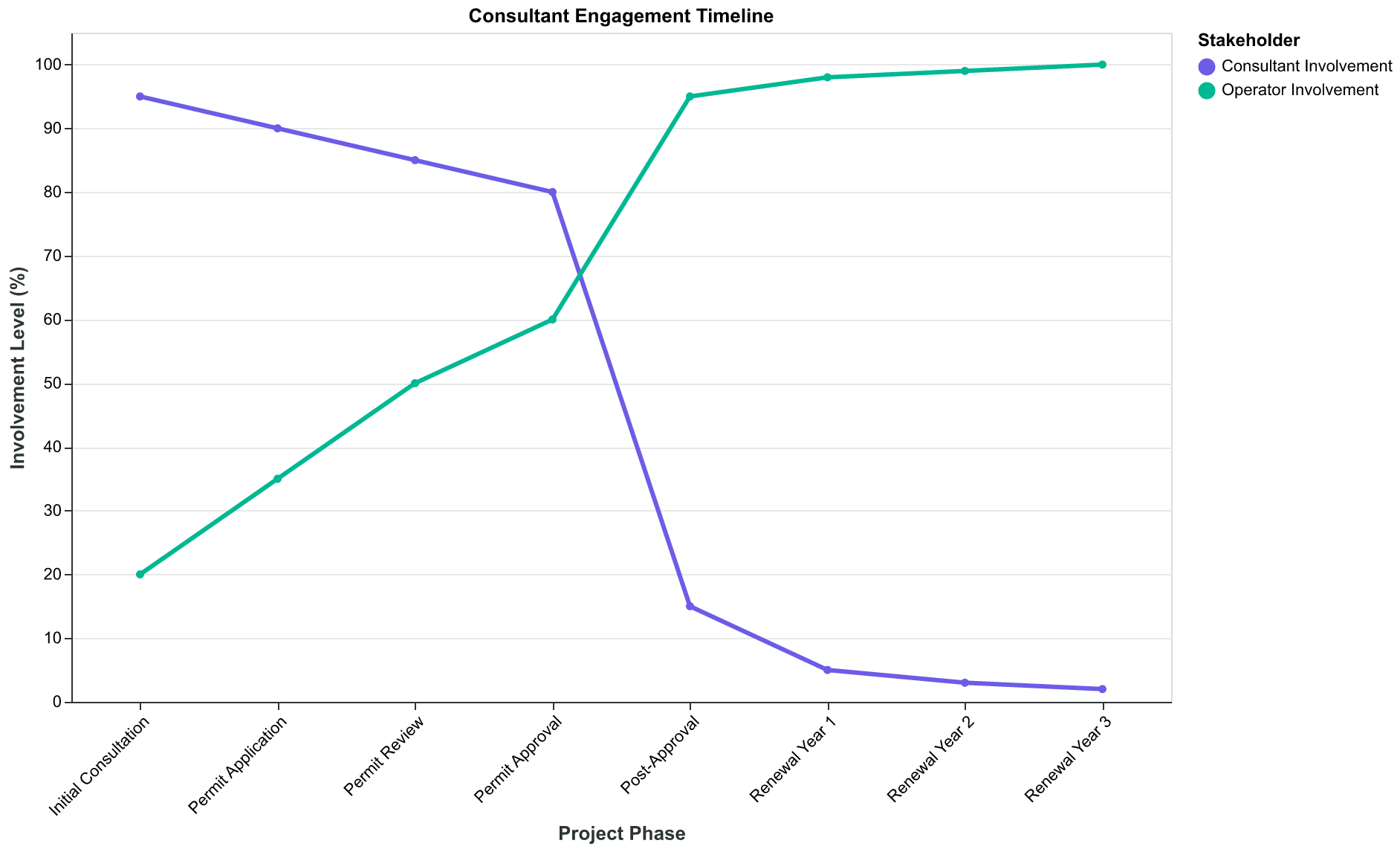
The result is fragmented renewal support across specialists: attorneys handle California Liquor License renewals, accountants manage business registration updates, insurance brokers track policy renewals, and fire safety contractors monitor Fire Department Operational Permit requirements.
No single professional maintains the complete renewal picture. When Casa Mia Italian missed their health permit renewal in Brooklyn, they discovered their opening consultant had closed that service line entirely. “He told us renewals were ‘straightforward’—just check the county website every year,” recalls owner Marco Benedetti. “What he didn’t mention was that three different agencies had three different renewal schedules, and missing one triggers automatic re-inspection of all permits.”
This consultant handoff problem creates the renewal blind spot that catches most operators unprepared.
Build Your Restaurant Renewal Tracking System
Here’s how to build the system that prevents renewal surprises.
The difference between compliant restaurants and those facing emergency closures comes down to one thing: systematic tracking that starts 90 days before any deadline. Not 30 days—agencies often need 4-6 weeks to process renewals, and peak renewal seasons create bottlenecks that extend processing times.
Step 1: Create your master renewal calendar. List every permit, license, and certification your restaurant holds. Include the issuing agency, renewal date, application window, required documents, and fees. This isn’t a simple spreadsheet—it’s your compliance lifeline.
Step 2: Set 90-day advance alerts. Configure three alerts per renewal: 90 days (start gathering documents), 60 days (submit application), and 30 days (follow up on processing). Most renewal disasters happen because operators wait until the month of expiration to begin the process.
Step 3: Standardize document packages. Each renewal type requires specific supporting documents. Create standard packages so you’re not scrambling to find certificates of insurance, floor plans, or employee training records when applications are due.
Step 4: Assign ownership by category. Don’t make one person responsible for all renewals. Assign health permits to your kitchen manager, business registrations to your accountant, insurance renewals to your office manager. But maintain central tracking so nothing falls through handoff gaps.
Step 5: Build compliance buffers. Apply for renewals 60-90 days early when possible. Early application protects against processing delays and gives you time to address any issues before expiration. Most agencies accept early renewals without penalty.
The Technology Component: Use shared calendars that multiple staff members can access and update. Google Calendar, Microsoft Outlook, or specialized compliance software—the platform matters less than consistent usage and clear ownership of each deadline.
Multi-Location Scaling: Create location-specific sub-calendars that roll up to a master view. Each location has unique local permits, but corporate-level registrations affect all locations. A missed state business registration renewal impacts every location in that state.
The system works because it accounts for the human factors that cause renewal failures: forgotten deadlines, misplaced documents, unclear ownership, and processing delays that turn minor administrative tasks into emergency crises.
Automated Renewal Tracking for Multi-Unit Operations
For restaurant groups, manual tracking becomes impossible at scale.
Instead of surprise fire department notices appearing on random Tuesdays, you see your complete renewal calendar across all locations, with automatic alerts that escalate based on compliance criticality and deadline proximity.
The ApronPrep renewal tracking system maintains compliance calendars for 50+ permit types across 200+ jurisdictions, with automatic alerts that adjust for local processing times and peak renewal seasons. When Austin’s outdoor dining permits come due in September, operators get alerts in June—not August when the rush begins.
Automated compliance monitoring becomes essential for restaurant groups managing multiple locations across different states and municipalities. Each location operates under different renewal cycles, different agencies, and different consequences for missed deadlines.
Frequently Asked Questions
What happens if I miss a renewal deadline?
Grace periods vary by agency, but violations start immediately. Most health departments offer a 30-day grace period with late fees ($50-$200), but your restaurant operates illegally during this time. Fire department permits often have zero grace period—miss the deadline, and you’re shut down until renewal is complete. The Health Department can issue violations that stay on your record even after renewal.
Can I renew permits early?
Yes, and you should. Most agencies accept renewals 60-90 days before expiration. Early renewal protects against processing delays and gives you buffer time if additional documentation is required. Annual Food License Renewal applications, for example, often take 3-4 weeks to process during peak renewal season.
Do all permits renew on the same schedule?
No—renewal cycles are intentionally staggered. Business licenses typically renew annually on your opening date. Public Health Permit renewals follow calendar years in most jurisdictions. Fire permits often renew every 2-3 years. Liquor licenses can be annual, biennial, or triennial depending on your state.
How do I track renewals across multiple locations?
Create a master calendar with 90-day advance alerts. Each location operates under different municipal requirements—your Chicago location follows Illinois (Chicago, Restaurant) compliance while your LA location follows California (Los Angeles, Restaurant) requirements. Use a shared spreadsheet with renewal dates, responsible staff member, and document requirements for each permit.
What documents do I need for each renewal type?
Standard renewal packages include proof of insurance, updated floor plans, and compliance certificates. Health permits require current employee food safety certifications. Fire permits need updated suppression system inspection reports. Business licenses require updated revenue declarations and tax clearance letters. Always request the specific document checklist from each agency—requirements change annually.
ApronPrep’s analysis of 157 cities reveals 250,000+ compliance data points showing significant variation in renewal requirements, processing times, and penalty structures across jurisdictions. The data demonstrates that renewal compliance operates as a complex system where individual permit deadlines interact with broader regulatory requirements.
Our methodology involves direct analysis of municipal codes, agency websites, and penalty structures across major metropolitan areas. We track changes in renewal requirements, processing times, and fee structures on a quarterly basis to identify trends that affect restaurant compliance.
Six months later, Maria gets a different kind of knock on her door. This time it’s a routine inspection, not an emergency shutdown. Her renewal calendar shows green across the board: food service establishment license renewed 30 days early, fire suppression inspection scheduled for next Tuesday, liquor license application already submitted with 45 days to spare.
The inspector pulls out his tablet, scans her compliance dossier, and nods. “Everything’s current. See you next year.” Five minutes. No violations. No panic.
Maria’s restaurant isn’t special because she has better food or a bigger budget. She’s special because she treats renewal compliance like the business-critical system it is. Fifteen different permits, seven different agencies, and she knows exactly when each one expires—not the day before, but 90 days out.
You have the same 365 days Maria had. The same permits. The same deadlines. The difference is whether you’re tracking them systematically or hoping nothing expires while you’re not looking.
Start your renewal audit today. Which of your permits expire in the next 90 days?
Because when the inspector knocks, the only thing that matters is whether your dossier is ready.
Be Ready When They Knock.
Check your city’s compliance requirements — free. Enter your city and restaurant type to see your complete renewal calendar with 90-day advance alerts.
Get Your Compliance Calendar
This article is part of the ApronPrep Compliance Intelligence Library. Data sourced from 150 cities across 50 states. Last verified: July 2026.