
Permits & Licensing Guide
Restaurant Compliance by Type: Complete Requirements Guide 2024
July 17, 2026 · 17 min read · 4,247 words
Maria had already signed the lease for her food truck when she discovered the truth about mobile vendor permits. The $3,000 “simple food service license” her consultant quoted was just the beginning. Each city she planned to visit required separate permits, renewal schedules, and inspection protocols. Portland alone had 14 additional requirements for mobile food vendors that nobody mentioned during her “comprehensive” compliance consultation.
By the time she mapped the actual permit landscape across her planned route — Portland, Seattle, Vancouver — she was looking at 47 different permits, licenses, and certifications. Her 30-day launch timeline became a 6-month regulatory odyssey.
The difference between generic advice and category-specific requirements isn’t just paperwork — it’s the difference between opening on schedule and watching your capital drain while you chase permits you never knew existed.
The Restaurant Compliance Delta Model
Every restaurant establishment type follows a predictable compliance pattern that either adds to, subtracts from, or modifies the full-service restaurant baseline. Understanding these patterns isn’t about memorizing permit lists — it’s about recognizing which regulatory domains activate based on your specific operational model.
The Delta Model works from a simple premise: compliance requirements cluster around operational risk factors. Full-service restaurants represent the complete risk spectrum: food preparation, customer seating, waste management, fire safety, and accessibility compliance. Every other establishment type represents a variation on this theme.
Food trucks subtract seating and accessibility requirements but add mobile vendor compliance. Ghost kitchens eliminate front-of-house regulations but intensify zoning restrictions. Bars amplify every alcohol-related requirement while potentially reducing food preparation complexity.
This isn’t about finding shortcuts — it’s about precision targeting. When you know your establishment’s compliance signature, you avoid the two costliest mistakes in restaurant compliance: over-engineering requirements you don’t need, and missing requirements that seem irrelevant but aren’t.
| Establishment Type | Baseline Modification | Key Added Requirements | Key Eliminated Requirements |
|---|---|---|---|
| Full-Service Restaurant | Complete baseline | None (this IS the baseline) | None |
| Fast-Casual/Counter | -15% complexity | Counter service protocols | Full table service requirements |
| Bars/Alcohol-Primary | +40% complexity | Liquor licensing, entertainment permits | May reduce kitchen requirements |
| Food Trucks | +25% mobile complexity | Multi-jurisdiction permits, commissary agreements | Fixed-location accessibility |
| Ghost Kitchens | -40% front-house | Delivery platform compliance, commercial zoning | Customer-facing requirements |
| Bakeries/Cafes | Mixed modification | Retail food licensing, specialized ventilation | Often exempt from grease trap requirements |
The Delta Model makes hidden compliance patterns visible, turning regulatory guesswork into systematic planning. When you understand which requirements activate for your concept, you can build accurate timelines, realistic budgets, and compliance strategies that actually work.
But here’s what the model reveals that generic advice misses: establishment types aren’t just about permits — they’re about permit sequences and dependencies. A food truck’s commissary agreement must be secured before mobile vendor permits can be processed. A bar’s liquor license prerequisites can extend the building permit timeline by 60-90 days.
The 67-Requirement Foundation: What Every Full-Service Restaurant Must Navigate
Before we explore how different establishment types modify the compliance landscape, let’s establish the baseline that everything else builds from.
Every full-service restaurant in America starts with the same compliance foundation: 67 average requirements spanning five regulatory domains. This isn’t the complete picture for any specific establishment — it’s the starting point before your concept, location, and local quirks add their layers of complexity.
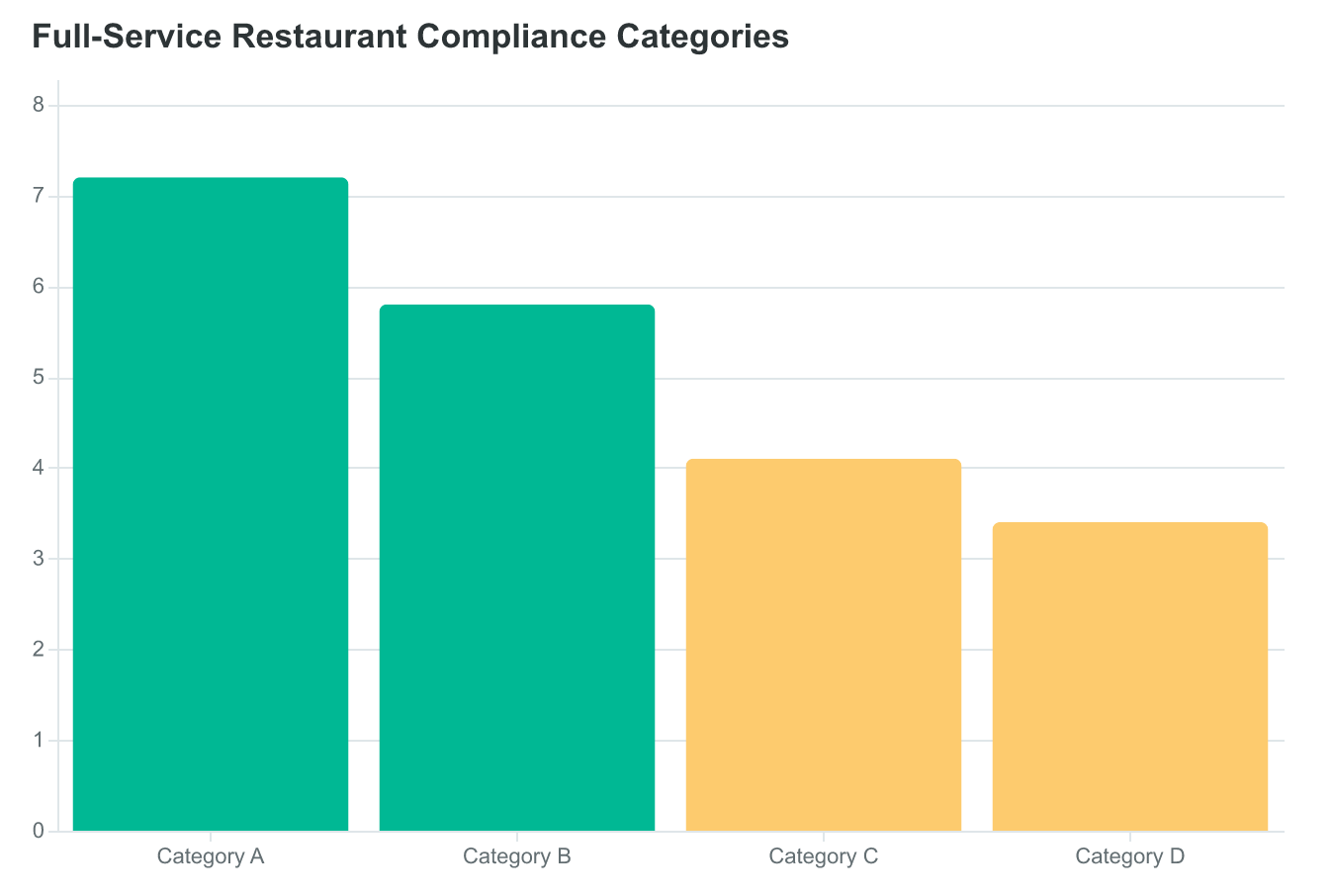
Our Compliance Intelligence analysis across 150 cities reveals that full-service restaurants face requirements in five core categories: health department permits (averaging 18 requirements), building and construction compliance (16 requirements), business registration and tax compliance (14 requirements), signage and accessibility permits (11 requirements), and fire safety certifications (8 requirements).
| Category | Average Requirements | Most Common Forms |
|---|---|---|
| Health Department | 18 | Food Service License, Public Health Permit |
| Building/Construction | 16 | Building Permit, Certificate of Occupancy |
| Business Registration | 14 | Business License, Tax Registration |
| Signage/Accessibility | 11 | Sign Permit, ADA Compliance |
| Fire Safety | 8 | Fire Department Permit, Sprinkler Inspection |
The variation within this “baseline” is striking. In Los Angeles, the Food Service Establishment License requires a 14-step process including plan review, while Birmingham’s Alabama Retail Food Establishment License consolidates similar requirements into 6 steps. Both cities require the same core health compliance, but the administrative machinery varies dramatically.
Boston adds 8 additional requirements to the baseline for accessibility compliance, including the Massachusetts Architectural Access Board AAB Compliance Cert. Chicago removes 3 signage requirements but adds 5 liquor-adjacent permits even for non-alcohol establishments. Each city’s interpretation of the same federal and state mandates creates this variation within the baseline.
The timing cascade matters as much as the count. In Los Angeles, the Building Permit must be approved before the Certificate of Occupancy review begins, which must be complete before the Public Health Permit inspection. This isn’t a 67-item checklist you can tackle in any order — it’s a dependency chain where each delay multiplies.
What surprises first-time restaurant owners is that this 67-requirement baseline assumes you’re opening the most straightforward possible restaurant: indoor dining only, no alcohol, no live entertainment, standard hours, and a conventional kitchen setup. The moment you add a patio, apply for a Liquor License, or want to stay open past midnight, you’re no longer working from the baseline — you’re customizing it.
Bars and Alcohol-Serving Establishments: The 90-Day Liquor License Reality
Now here’s where the complexity multiplies fast.
When Maria decided to add a full bar to her Italian restaurant, she thought it meant filling out “a couple extra forms.” Six months later, she was still waiting for her final permits while paying rent on a space she couldn’t legally operate.
Bars and establishments serving alcohol don’t just add a few permits to the restaurant baseline — they trigger an entirely separate regulatory pathway that can increase your compliance requirements by 15-25 additional permits and licenses.
| Permit Category | Restaurant Only | Restaurant + Bar | Additional Requirements |
|---|---|---|---|
| Core Operations | 8-12 permits | 8-12 permits | Same baseline |
| Liquor Licensing | 0 | 3-7 permits | State + local + federal |
| Entertainment | 0 | 2-4 permits | Live music, dancing, extended hours |
| Fire Safety | 2-3 permits | 4-6 permits | Occupancy increases, sprinkler mods |
| Total Range | 10-17 permits | 25-42 permits | +15-25 permits |
The California Liquor License On Premises alone requires a 90-day waiting period — and that’s assuming you submit a perfect application. Most first-time applicants get kicked back for missing documentation, adding another 30-60 days to the timeline.
But the Liquor License is just the beginning. Serving alcohol triggers cascading requirements that restaurant owners rarely anticipate:
- Entertainment permits if you plan live music or dancing (even acoustic guitar requires permits in most cities)
- Extended hour permits for service past 2 AM
- Modified Fire Safety requirements because alcohol service increases occupancy classifications
- Additional Health Department inspections focused on food safety in alcohol-serving environments
- Workers’ Comp insurance requirements that can triple your liability premiums
The timeline impact is where bar owners get blindsided. Bars typically need 120-180 days minimum to open, while a standard restaurant can open 45-60 days after lease signing. The Wine and Beer Certificate of Compliance process alone can stretch 8-12 weeks in slower jurisdictions.
What makes this particularly painful is the permit interdependency. You can’t get your final fire department approval until your Liquor License is processed. You can’t schedule your Health Inspection until your entertainment permits are approved. One delayed permit cascades through your entire opening timeline.
The operators who succeed plan for alcohol licensing as a separate project with its own timeline, budget, and compliance tracking. They don’t treat it as “restaurant plus drinks” — they treat it as “restaurant plus regulated substance distribution,” which is exactly what alcohol service legally represents.
Food Trucks: When Your Restaurant Crosses City Lines
Here’s where mobility becomes a compliance nightmare.
Food trucks face a unique challenge in the restaurant compliance landscape: they’re restaurants that move. This mobility creates a compliance multiplication effect that catches most operators off-guard. Instead of satisfying one jurisdiction’s requirements, food trucks must navigate overlapping local, county, and state regulations in every location they serve.
The baseline requirements start familiar — Food Service License, Health Permit, business registration — but then mobile-specific layers activate. Every city line crossed adds another layer of compliance requirements to track, renew, and maintain.
Mobile Vendor Permits are just the beginning. Most cities require separate applications with location-specific restrictions: where you can park, what hours you can operate, whether you need additional fire extinguishers for outdoor cooking. Portland requires mobile vendors to maintain a 200-foot distance from brick-and-mortar restaurants during peak hours. Los Angeles has different parking restrictions for each district.
Commissary Agreements represent another hidden complexity. Health departments require food trucks to prep, store, and clean at licensed commissary kitchens — you can’t just work out of your home kitchen. These agreements must be in place before mobile permits get approved, and commissaries often have waiting lists during busy seasons.
| Compliance Area | Traditional Restaurant | Food Truck Requirements |
|---|---|---|
| Base Operations | Single-location permits | Multi-jurisdiction permits |
| Food Prep | On-site kitchen | Licensed commissary required |
| Health Inspections | Annual at fixed location | Per-jurisdiction + mobile unit |
| Fire Safety | Building-integrated system | Portable suppression + local approvals |
| Parking/Zoning | Not applicable | City-specific location restrictions |
| Waste Management | Municipal pickup | Mobile waste + grease disposal |
The renewal cycles create ongoing administrative burden. Your Los Angeles mobile vendor permit expires in December, your commissary agreement renews in March, and your Portland permit comes due in June. Miss any renewal and you’re operating illegally in that jurisdiction.
What makes food truck compliance particularly treacherous is the enforcement variation. Some cities actively patrol and fine non-compliant mobile vendors. Others rely on complaint-driven enforcement. But when you get caught without proper permits, the penalties often include vehicle impoundment — your entire business gets towed.
Successful food truck operators treat compliance as fleet management. They maintain spreadsheets tracking permit expiration dates across all operating territories, budget for multiple renewal fees, and build relationships with permit offices in their primary markets. They don’t try to “figure it out as they go” — they map their compliance requirements before they hit the road.
Ghost Kitchens: 40% Fewer Requirements, Same Food Safety Standards
But what if you could skip most of the complexity entirely?
Ghost kitchens represent the simplest compliance path in the restaurant industry — think of them as “restaurants minus customers.” By eliminating front-of-house operations, ghost kitchens avoid roughly 40% of traditional restaurant requirements while maintaining the same food safety and preparation standards.
The compliance reduction is dramatic. No customer seating means no ADA accessibility requirements, no dining room fire suppression, no Music License considerations. No storefront means no signage permits, no retail zoning compliance, no public restroom mandates.
What remains is pure commercial kitchen compliance: Food Service License, Health Permit, commercial Building Permit approval, and basic business registration. The requirements that stay are the ones focused on food safety — the ones that matter regardless of where customers consume your product.
But ghost kitchens create their own compliance wrinkles. Commercial kitchen zoning is often more restrictive than restaurant zoning. Many mixed-use buildings that allow restaurants won’t permit commercial kitchens due to ventilation, noise, and delivery traffic concerns.
Delivery platform compliance adds a layer that traditional restaurants don’t face. Each platform — DoorDash, Uber Eats, Grubhub — has different requirements for insurance coverage, food handling protocols, and order fulfillment tracking. While these aren’t government permits, they’re operational requirements that affect your ability to generate revenue.
| Compliance Category | Traditional Restaurant | Ghost Kitchen | Requirement Change |
|---|---|---|---|
| Health/Food Safety | Full requirements | Full requirements | No change |
| Building/Zoning | Restaurant zoning | Commercial kitchen zoning | Different, not simpler |
| Customer-Facing | 15-20 requirements | 0 requirements | Complete elimination |
| Fire Safety | Dining + kitchen | Kitchen only | Significant reduction |
| Platform Compliance | Not applicable | Multiple platform requirements | New category |
The timeline advantage is substantial. Ghost kitchens can often open 60-80 days faster than equivalent restaurants because they skip the lengthy processes around customer accessibility, dining room construction approval, and occupancy calculations.
What surprises ghost kitchen operators is that “simpler compliance” doesn’t mean “no compliance planning.” The requirements that remain — particularly commercial zoning and delivery platform integration — require the same systematic approach as traditional restaurant compliance. You’re not avoiding compliance complexity; you’re concentrating it in different areas.
Bakeries and Cafes: When Preparation Method Rewrites the Rules
Then there’s the establishments where what you make determines what you need.
When Flour & Fire Bakery opened in Portland, the owners thought their compliance path would be simple — just a basic Food Service Establishment License and they’d be baking by month’s end. Six weeks later, they were still navigating a web of requirements that nobody had warned them about.
The issue wasn’t what they expected to need. It was what they didn’t expect NOT to need — and what got added because of how they prepared food.
Bakeries and cafes operate from a modified restaurant baseline that hinges on one critical distinction: food preparation method. Unlike full-service restaurants that require comprehensive grease management systems, most bakeries can skip Grease Trap installation entirely. The absence of deep frying or heavy oil cooking eliminates this $8,000-$15,000 infrastructure requirement.
But preparation method giveth and taketh away. While bakeries dodge grease traps, they face ventilation requirements that can be more complex than traditional restaurants. Commercial ovens operating 12+ hours daily require specialized exhaust systems designed for flour particulates and high-temperature baking — not just standard kitchen ventilation.
| Compliance Area | Traditional Restaurant | Bakery/Cafe Modification |
|---|---|---|
| Grease Management | Type 2 Hood + Grease Trap Required | Often Exempt (unless frying) |
| Ventilation | Standard Kitchen Exhaust | Specialized Flour/Heat Exhaust |
| Retail Food License | Not Required | Required if Selling Packaged Goods |
| Fire Suppression | Ansul System Standard | Modified for Oven-Heavy Operations |
| Zoning Classification | Restaurant/Food Service | May Qualify as Retail/Light Commercial |
The real compliance curveball comes when bakeries add retail components. Selling packaged pastries, coffee beans, or prepared sandwiches triggers retail food licensing requirements that pure restaurants never encounter. This isn’t just paperwork — it’s a different regulatory category with distinct storage, labeling, and inspection protocols.
Zoning presents another hidden advantage. Many municipalities classify bakeries as light commercial or retail rather than food service, opening location options that restaurants can’t access. A bakery might operate in a mixed-use building where a full restaurant would violate zoning compliance requirements.
The key insight: bakery compliance isn’t restaurant compliance minus complexity — it’s a different compliance pattern entirely. Understanding this distinction prevents the common mistake of over-engineering requirements for operations that don’t need them, while ensuring you don’t miss the specialized requirements that do apply.
Specialty Establishments: When Two Business Models Collide
Some concepts don’t fit clean categories — and that’s where compliance gets interesting.
Specialty establishments — brewery-restaurants, market-cafes, entertainment venues with kitchens — face the most complex compliance landscapes because they trigger multiple regulatory frameworks simultaneously. Each additional business model doesn’t just add permits — it activates entirely different regulatory domains with their own timelines, dependencies, and renewal cycles.
Brewery-restaurants must satisfy both food service regulations and alcohol manufacturing requirements. This isn’t just restaurant permits plus Liquor License — it’s restaurant compliance plus federal brewing permits, state manufacturing licenses, and local industrial zoning approvals. The brewing operation may require different health department oversight than the restaurant kitchen.
Market-cafes that sell groceries alongside prepared food navigate retail food licensing, restaurant health codes, and potentially agricultural product regulations if they source directly from farms. Each product category — prepared foods, packaged goods, fresh produce — may fall under different inspection schedules and compliance standards.
Entertainment venues with food service face the most complex matrix. Live music venues need entertainment permits, sound ordinance compliance, and often late-night operational approvals. When you add a kitchen, you’re layering restaurant compliance on top of entertainment venue requirements that may conflict in areas like occupancy calculations and fire safety planning.
| Specialty Type | Base Requirements | Additional Domains | Regulatory Conflicts |
|---|---|---|---|
| Brewery-Restaurant | Restaurant + Manufacturing | Federal brewing, state production | Different health oversight agencies |
| Market-Cafe | Restaurant + Retail | Agricultural products, packaged goods | Multiple inspection schedules |
| Entertainment + Food | Restaurant + Venue | Live music, late hours, sound ordinances | Occupancy vs. dining calculations |
| Catering Operations | Restaurant + Mobile | Multi-jurisdiction permits, transport licenses | Mobile vs. fixed-location health codes |
The permit sequencing becomes critical with specialty establishments. Brewery licensing often requires the restaurant permits to be approved first. Entertainment venue approvals may conflict with restaurant occupancy calculations, forcing redesigns mid-process.
What catches specialty operators off-guard is that combining business models doesn’t create additive compliance — it creates multiplicative compliance. A brewery-restaurant doesn’t need “restaurant permits plus brewing permits” — it needs permits that satisfy both frameworks simultaneously, which often requires custom solutions that standard guidance doesn’t address.
The Compliance Pattern Matrix: Where Each Type Fits
Seeing all the patterns side by side reveals something crucial about restaurant compliance.
When you map all six establishment types across the eight major compliance categories, a clear hierarchy of complexity emerges that directly correlates with operational scope and risk exposure.
The data reveals three distinct compliance tiers. Fast-casual and food trucks occupy the baseline tier (12-18 permits average), primarily because they avoid the high-risk categories that trigger additional oversight. Counter-service establishments add moderate complexity (16-22 permits) by introducing limited seating requirements.
Full-service restaurants represent the complexity peak (22-28 permits), requiring the complete compliance spectrum from Public Health Permit through California Liquor License On Premises. Bars match this complexity despite smaller food operations because alcohol licensing creates its own regulatory web.
Catering operations break the pattern entirely. Their mobile nature creates a compliance multiplication effect — they need base permits in their commissary jurisdiction plus conditional permits in every service territory. What appears simple operationally becomes the most administratively complex restaurant model.
Understanding these patterns prevents the classic mistake of planning timeline and budget based on one establishment type when your concept actually fits a different compliance category. A “simple coffee shop” that adds beer and wine service isn’t simple anymore — it’s a bar with limited food service, requiring the full alcohol compliance pathway.
How to Map Your Restaurant’s Exact Compliance Requirements
Knowing the patterns is step one. Applying them to your specific situation is where the real work begins.
The compliance maze becomes navigable when you follow a systematic approach. Here’s how to determine your establishment’s exact requirements without missing critical permits or wasting time on irrelevant ones.
Step 1: Identify Your Baseline Type (Time: 30 minutes)
Start with the core question: what’s your primary service model? Full-service restaurant, fast-casual, or counter service? This baseline determines 70% of your permits. A full-service restaurant in Los Angeles needs the Food Service Establishment License plus seating capacity approvals. Counter service skips the seating requirements but adds different health department protocols.
Don’t guess based on similarity to other restaurants. The permit office categorizes by specific operational characteristics: do customers order at a counter or table? Do you serve alcohol? These distinctions matter more than your marketing positioning.
Step 2: Map Your Add-On Services (Time: 45 minutes)
Each additional service layer adds specific permits. Alcohol service requires Liquor Licenses with 60-90 day processing times. Live entertainment needs separate permits and noise compliance. Mobile operations require permits in every city you operate — food truck permits don’t transfer between jurisdictions.
Retail add-ons (selling packaged goods) trigger different health department categories and may require separate business licenses. Outdoor seating adds ADA compliance requirements and potentially zoning compliance letters.
Step 3: Check City-Specific Variations (Time: 1 hour)
Every city modifies the state baseline. Chicago requires Grease Trap permits that don’t exist in most other Illinois cities. Los Angeles has specific Building Permit requirements that differ from San Francisco’s process. Never assume your research from one city applies to another, even within the same state.
Check your city’s restaurant-specific requirements on their official website. Call the business license office directly — they know which permits trip up restaurant owners most frequently.
Step 4: Sequence by Timeline Dependencies (Time: 2 hours)
Some permits require others as prerequisites. You can’t get your Certificate of Occupancy until Building Permits are approved. Liquor Licenses often require your basic business license first. Map these dependencies on a timeline working backward from your planned opening date.
Permit offices consistently underestimate timelines, especially during busy seasons — allow 30% more time than quoted processing periods.
Common Mistake: Assuming permits transfer between locations or cities. Each jurisdiction requires separate applications, even for identical restaurant concepts. Plan for location-specific Compliance Research every time you expand.
ApronPrep’s Authority Expert Agents automatically map compliance variations across 150 cities, identifying permit dependencies and timeline conflicts before they derail your opening. The system tracks requirement changes in real-time, ensuring your compliance roadmap stays current as regulations evolve.
Maria never opened that food truck. But she didn’t abandon her dream — she pivoted to a ghost kitchen instead. The compliance pattern for her delivery-only concept was completely different: no mobile vendor permits, no commissary agreements, but stricter zoning requirements for commercial kitchens in mixed-use buildings. She knew this before she signed her lease, not after.
The difference between success and expensive surprises isn’t luck — it’s pattern recognition. Every establishment type has its compliance signature. Food trucks need mobility permits that restaurants don’t. Bars need liquor compliance that cafés skip. Ghost kitchens navigate delivery platform requirements that brick-and-mortar locations never see.
Your establishment type determines your compliance roadmap. Miss a pattern-specific requirement, and you’re looking at delays, fines, or worse — opening day pushed back while you scramble for the Public Health Permit you didn’t know you needed.
Download the Establishment Type Compliance Checklist to map your specific requirements before you sign anything.
The inspector doesn’t care that you thought coffee shops and restaurants had the same rules — they care that you have the right permits when they knock. Know your pattern. Get it right the first time.
Be Ready When They Knock.
Check your city’s compliance requirements — free. Enter your city and restaurant type below to see your exact permit list, processing times, and cost estimates.
Get My Compliance Requirements
This article is part of the ApronPrep Compliance Intelligence Library. Data sourced from 150 cities across 50 states. Last verified: July 2026.